The People Still Showing Up · Queensland · Mary River repair
The River Was Brown. They Brought a Testing Kit.
Along Queensland's Mary River, volunteers, farmers and rangers are measuring the damage and rebuilding banks, habitat and trust one practical job at a time.
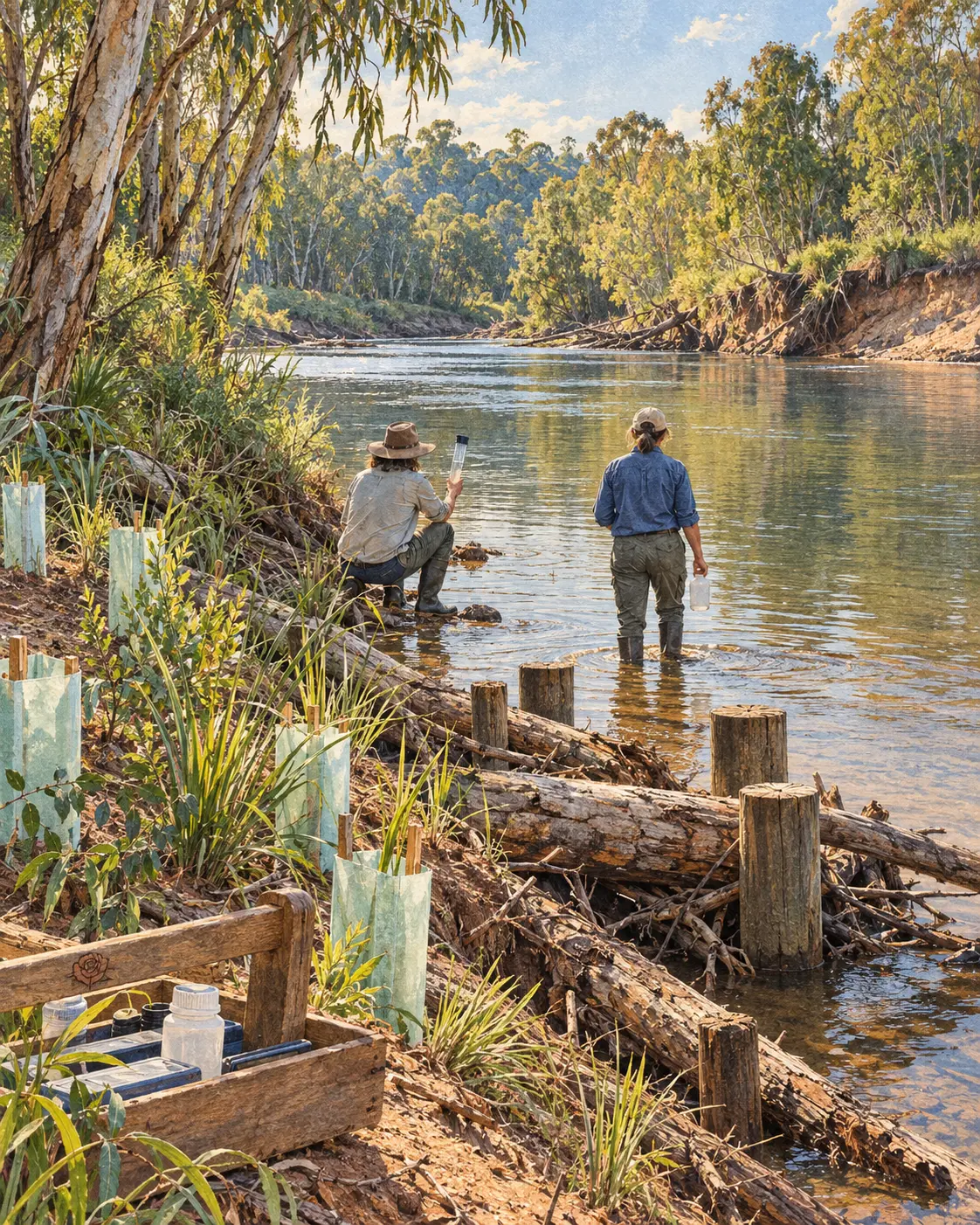
The kit asks small questions of a big river: temperature, pH, salinity, E. coli, dissolved oxygen and turbidity. Nearly 80 volunteers now sample 103 sites across 81 waterways in Queensland's Mary River catchment. The gear is not glamorous. Rivers have never cared much for launch breakfasts. But repeat the same tests, month after month, and memory becomes evidence.
That matters when the water comes down brown. During the 2022 flood, sediment from the Mary spread into Great Sandy Strait, where seagrass feeds fish, turtles and dugongs. ABC Rural reported an estimate that 66 per cent of that load came from streambank erosion. It also reported that one farming family lost four hectares beside the river in a single 2013 flood. Soil does not merely vanish. It changes address.
A river carrying old decisions
The damage does not have one neat villain. In the Gympie reach, MRCCC's 2026 restoration record describes more than a century shaped by gold mining and quarrying. Elsewhere, cleared banks, cattle access, unsealed roads, weeds and poorly contained farm nutrients have all added pressure. Floods then apply the wrench. The result can be a riverbank sliced away, fine sediment travelling downstream and habitat stripped from threatened fish and turtles.
There is an economic story under the mud. Peter and Elke Watson began fencing cattle away from vulnerable banks and planting thousands of trees in the 1980s. They later survived droughts, floods, dairy deregulation and the era of supermarket milk sold for one dollar a litre. Cheap milk did not single-handedly erode the Mary. It did squeeze some of the same farmers being asked to spend time, land and money repairing it. The aisle price was simple. The catchment ledger was not.
Timber, roots and less nonsense
The repair is pleasingly mechanical. At badly eroded sites, crews reshape banks, drive rows of untreated hardwood poles into the ground and replant native vegetation. The poles slow floodwater; roots bind soil. Sixteen of these pile fields have been installed at difficult sites. MRCCC estimates they keep 27,000 tonnes of fine sediment a year from travelling toward the reef. That is the organisation's catchment estimate, not a separate measurement of every pole and planting. It should be read as a serious programme claim, not holy writ chiselled into a gum tree.
Underwater, Kabi Kabi and Jinibara rangers have helped install ethically sourced hollow timber as nesting habitat for endangered Mary River cod. Researchers later filmed a male guarding eggs inside one. On farms, other projects fence and replant riparian corridors, improve dairy-effluent systems and test ways to keep sediment and nutrients on the paddock rather than sending them downstream. The river does not need a single miracle. It needs a hundred ordinary jobs finished properly.
Who pays, and who keeps showing up
This is not an unfunded fairy tale. Local councils support Waterwatch equipment, calibration, coordination and reporting. The Australian Government funds the Gympie urban river work through the Natural Heritage Trust. Queensland backs the wider integrated project, and Seqwater invests because healthier source water reduces pressure on treatment infrastructure. Landholders contribute labour, access and in-kind work. Public money, utility money and private effort are all in the machine. That is how repair should look: the cost shared upstream instead of dumped downstream.
What is still uncertain? The programme's long list of plantings, pile fields and farm upgrades does not mean every ecological outcome has been independently measured. One February 2026 flood was an encouraging early test for revegetated areas in Gympie, not a final verdict on a 9,595-square-kilometre catchment. Decades of work remain, and the people taking samples cannot regulate land use or write infrastructure budgets with a turbidity tube.
One hour that becomes a record
MRCCC says its Munna Creek Waterwatch network has recently worked with limited funding and needs a new generation of local samplers. The ask is precise: about one hour a month, with training and equipment provided. If you live in the catchment, use the official Waterwatch page to contact the team. If you live elsewhere, share that route with somebody local rather than flinging sympathy across the internet like confetti. No donation or partnership is claimed here.
Enough is enough can sound like a shout. On the Mary, it also sounds like a sample bottle clicking shut, a fence going up, a log rolled into place and a farmer deciding the bank will not be left naked for the next flood. Quiet work is still resistance. It simply wears older boots.
I’ll leave you today with a line from Peter Watson, Mary River dairy farmer, speaking to ABC Rural:“It's also created an environment that you're happy to work in and live in.”
Sources & ways to help
How to help: contact MRCCC about joining Waterwatch →Official MRCCC route checked 6 October 2026. It includes current monitoring reports and direct contact details; the 2026 CodLine says training and equipment are provided and sampling takes about one hour a month.
Read the Mary River Restoration Plan for the Gympie reach →MRCCC's current primary restoration plan, listed by the organisation on 17 June 2026.
Read MRCCC's 2026 CodLine →Primary programme record covering Waterwatch, Gympie river repair, cod habitat, farm projects, funders and stated limits.
Read the independent report →ABC Rural, 26 September 2026. Reports the landholders, restoration methods, funding context, programme estimates and remaining work.
Read another Australian story about volunteers turning observation into evidence →
Follow the thread