The Rose Mission · Seadragons · Citizen science
The Seadragon and the Missing Baseline
After South Australia’s harmful algal bloom, citizen scientists counted nearly 1,700 dead seadragons. Their painstaking record also exposes what we still cannot measure about recovery.
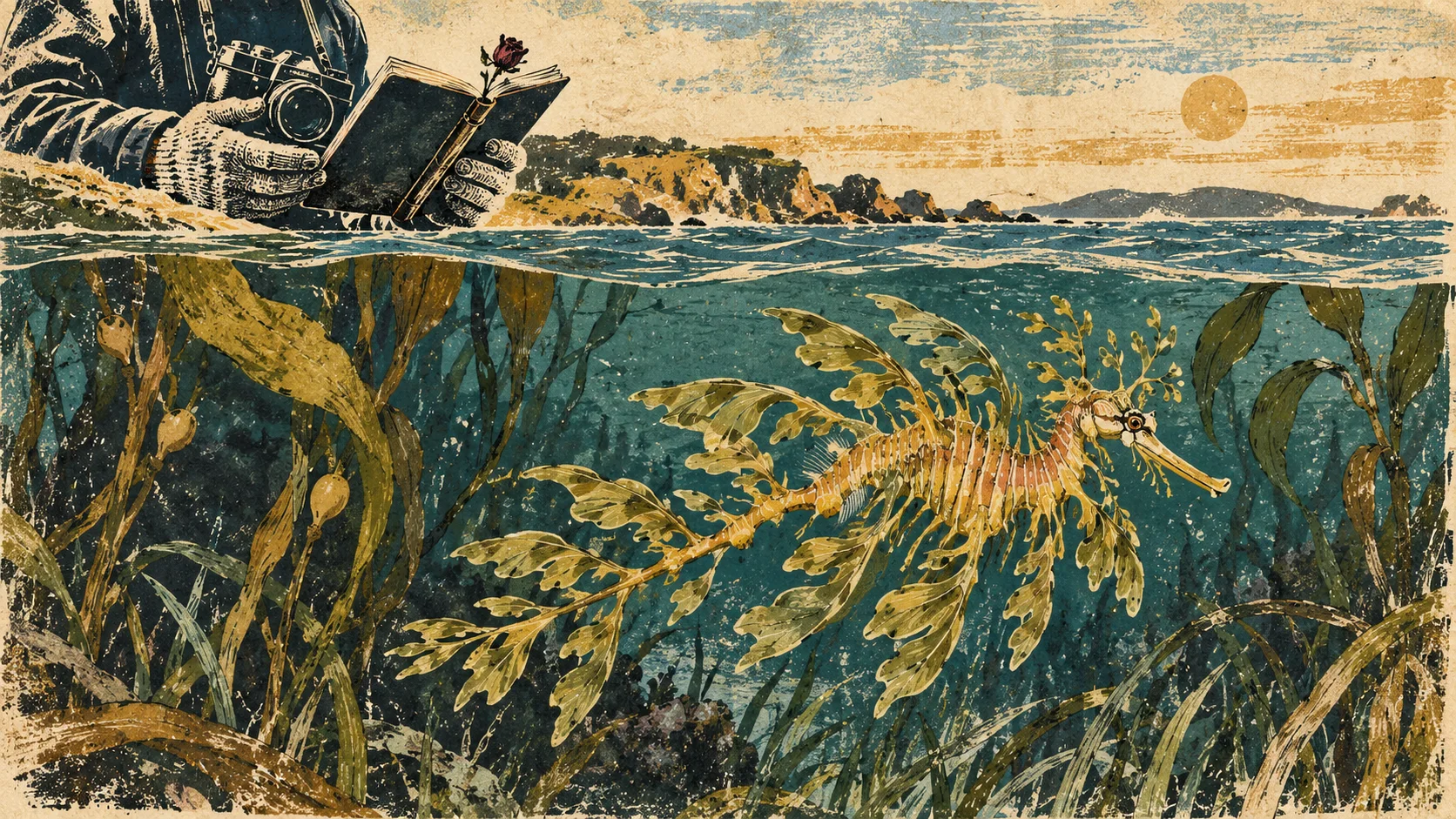
A photograph of a leafy seadragon can carry more information than a souvenir of a good dive. Its head markings, appendages and the shape of its snout can help a trained observer recognise the same small fish years later. That is how Dragon Search South Australia has built a record one image at a time. It is painstaking, mostly volunteer work; the sea does not issue a spreadsheet at closing time.
In September 2026, the record acquired a terrible new purpose. An analysis led by marine scientist Janine Baker documented approximately 1,524 dead weedy seadragons and 159 dead leafy seadragons in South Australia through 31 May. The tally came from about 1,540 citizen-science reports by 253 observers, supplemented by identification work and some official beach-cleanup records. It describes documented wash-ups, not an estimate of every animal lost.
What the shore returned
A harmful algal bloom first identified near the Fleurieu Peninsula in March 2025 spread through parts of the state’s coastal waters. Small gill openings make seadragons and their relatives vulnerable when harmful microalgae become dense; these delicate fish cannot simply outrun a bad patch. Their seagrass, kelp and sponge habitat also took damage. Some animals washed ashore and were photographed. Others may have died beyond anyone’s view. The distinction matters when a large number begins to sound complete.
The report records deaths across 13 species of seadragons, pipefishes and seahorses. It thanks 149 people who helped identify observations, as well as the 253 who submitted them. Most contributors did not deliver a heroic heap of records: 207 uploaded between one and nine. One careful sighting is still evidence. The work did not begin when a headline appeared; Dragon Search’s community-run photo-identification project has continued since 2013, with earlier roots stretching back to 1995.
ABC Adelaide reported on 17 September that some live juveniles have since been seen in monitored near-shore areas. That is welcome. It is not a population recovery certificate. Baker told ABC that numbers in familiar inshore habitats are lower than before the bloom, while offshore numbers remain undocumented. The report says there has been no systematic official survey of these populations before and after the event. With no dependable baseline, the phrase ‘back to normal’ has nowhere honest to stand.
The water looks calmer. The question stays.
There is a second date worth keeping beside the mortality count. South Australia’s situation update of 23 September says moderate to strong marine heatwave conditions persisted across both gulfs, while satellite imagery showed changing patches of elevated chlorophyll. Its own warning is important: chlorophyll on a satellite image does not prove the presence of the harmful Karenia algae. Water samples must do that job. The government’s public site says most of the coastline has shown zero or low Karenia levels since February, while monitoring continues.
Two truths can share a coastline: current algae readings may be low in most tested waters, and the damage from an earlier bloom may last much longer. An October breeding season and a photograph of a living dragon will not settle how many adults remain, whether nursery habitat supports the young, or what a later warming spell might bring. Researchers are exploring habitat repair and ways to help young seadragons survive. Those are investigations, not a released population or a promised fix.
It would be satisfying to nominate one villain, fit the whole bloom on a placard and go home. The evidence does not license that. The immediate mechanism is documented; the precise contribution of each environmental driver to its onset and persistence remains a scientific question. Governments are sampling and publishing updates. The fair question for them is whether sustained, comparable habitat and population surveys will continue after the dramatic pictures leave the news.
A useful place to put your attention
If you find an extensive fish kill on a South Australian coast, follow the government’s current advice and report it to FISHWATCH rather than handling or collecting animals. Avoid discoloured or foamy water and check health advice before entering. For divers and photographers who already work safely and lawfully, Dragon Search South Australia provides an official citizen-science participation route. Do not approach or disturb seadragons to make a photograph, and do not publish sensitive locations casually.
Know a small, independent crew doing careful marine monitoring or repair? Nominate it with a public source and its permission; we cannot promise coverage or help. Dragon Search’s observers have already done the quiet part: they looked, recorded, compared and left a record for the next person. No one can bring those animals back with a spreadsheet. Without one, we might not even notice what is missing.
I’ll leave you today with a line from Mary Oliver, ‘Sometimes’:“Pay attention. Be astonished. Tell about it.”
Sources & ways to help
Read Dragon Search South Australia’s report →The primary analysis covers observations from January 2025 to May 2026 and explains its methods and limits.
Meet the Dragon Search community →The Great Southern Reef Foundation explains the long-running photo-identification work and links to the project’s participation route.
Read ABC Adelaide’s independent report →Published 17 September 2026; includes researcher interviews, signs of surviving juveniles and the survey gap.
See the South Australian government’s 23 September update →Current heat, chlorophyll and circulation observations, with the explicit caution that chlorophyll is not a Karenia test.
Use the official algal-bloom reporting and safety page →The South Australian government lists FISHWATCH for extensive fish kills and a separate wildlife-disease hotline for sick or dead marine mammals and birds.
Find the Dragon Search South Australia project →The participation route linked from the Great Southern Reef Foundation’s Dragon Search page; follow project and wildlife-handling guidance.
Read our earlier story about northern ghost-net ranger teams →
Follow the thread