The Cost Nobody Prints · Thailand / Myanmar · river pollution and mineral traceability
The Water Had a Number. The Mineral Had No Address.
Mae Sai river communities have official arsenic and lead readings, but the mineral trade running from Myanmar through Thailand still lacks the traceability needed to follow responsibility upstream.
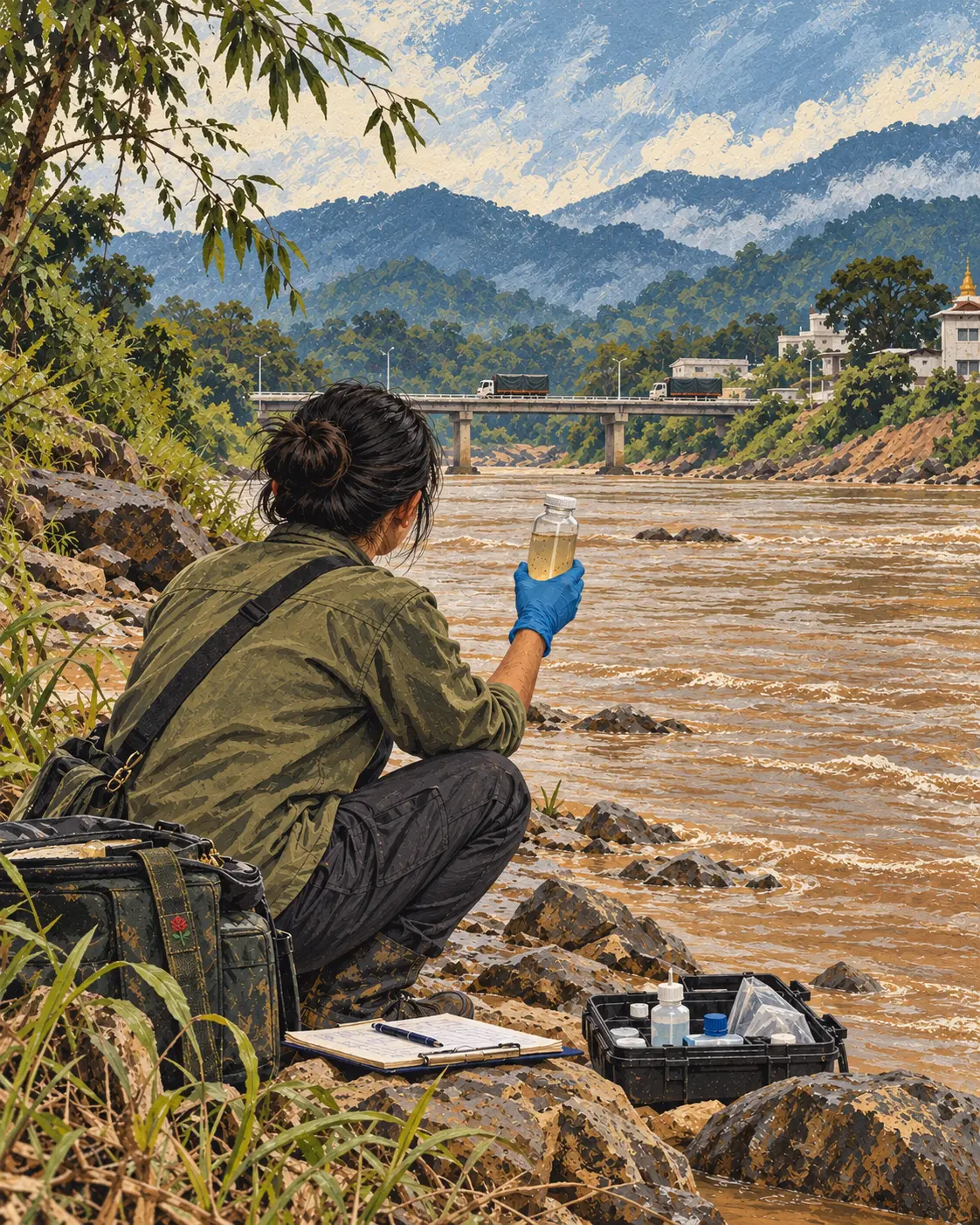
At Ban Hua Fai on the Sai River, an official water sample carried two blunt numbers: arsenic at 0.284 milligrams per litre and lead at 0.266. Thailand's surface-water limits are 0.010 for arsenic and 0.05 for lead. The bottle had an address. The mineral trade feeding the mess often did not.
That is the racket hiding in plain sight along this border. Muddy water moves downstream into farms, taps and fishing grounds. Ore moves the other way with trucks, invoices and customers. One journey is tested in public. The other can still lose the name of the mine somewhere between a sack and a spreadsheet. A marvellous little administrative miracle, if you happen to profit from amnesia.
Twenty-two rounds, and still no clean answer
The Thai Pollution Control Department's round-22 report covers samples taken from 3 to 7 August 2026 across the Kok, Sai, Ruak and northern Mekong system. It records arsenic above the surface-water standard at sites on all four rivers and lead above the standard at all three Sai River stations. Results vary by river, site, date and whether the sample is water or sediment. This is not evidence that every reach of the Mekong is uniformly unsafe. It is evidence that repeated local exceedances are real and the public deserves the tables, not a soothing shrug.
On 12 October, the People's Network to Protect the Kok, Sai, Ruak and Mekong Rivers brought farmers, water users, academics, officials and local businesses together at Wiang Phang Kham in Mae Sai. The department confirms it presented the monitoring record there. Thai PBS reported farmers asking the question that tends to disappear inside a risk-management slide deck: if contaminated irrigation ruins a crop, who carries the loss?
The forum heard that roughly 68,000 rai of farmland depends on the Sai system. Authorities described further soil, crop, fish and health surveillance, short-term water treatment and longer plans for alternative supply. Those measures matter. Monitoring tells people where danger may be. It does not stop the activity upstream, identify the responsible mine or replace income lost while officials search for a cleaner pipe.
The profitable road runs through a fog
Mongabay's 1 October investigation found more than 50 Thai-registered companies importing critical minerals from Myanmar. Government data reviewed by its reporters showed 105,752 tonnes of antimony, tungsten, copper, lead and manganese imported in the first nine months of 2025, worth more than 13.9 billion baht, with much of it re-exported to China. Demand reaches defence, electronics, engines, batteries and industrial alloys. The clean-looking product at the far end can have a very muddy childhood.
Here is the necessary brake on a hard story: the reviewed evidence does not connect a named Thai importer, shipment or mine to a named contaminated sample. Several importers told Mongabay that official trade records were wrong or that they could not identify the mine of origin. Thepthrni denied that its mines caused the pollution. Thai Customs and the Pollution Control Department did not answer Mongabay's written questions about trade data and the minerals that may be responsible. Scale, silence and profit are reasons to investigate. They are not a verdict.
The supply-chain failure is nevertheless concrete. If an importer cannot say which mine filled the bag, regulators cannot reliably match environmental harm to production, buyers cannot screen out damaging sources and communities cannot follow the money back to the gate. Traceability is not decorative paperwork. It is the mechanical linkage between a poisoned sample and somebody being required to fix the cause.
The people asking for more than another sample
The river network is asking for clean water, public health protection, a local laboratory and transparent mineral tracing. At the forum, academics also proposed opening import, export, machinery and chemical records and considering restrictions on mineral flows tied to damaging mines. These are proposals, not adopted policy. The government response remains a mix of monitoring, treatment plans, parliamentary pressure and cross-border discussion. The test now is whether any of it reaches the source.
There is no verified fundraiser attached to this article, and no invitation to go hunting for mines or residents. Follow the network's own public information, share the official readings, and keep one question in the room: will the mineral be traceable before the next bottle comes back with another number? The river has done enough unpaid evidence work.
Enough is enough can be very quiet. A transparent manifest. A published laboratory table. Clean water that does not arrive as a future budget promise. Then, when the source is proved, repair paid for by the people who made and sold the risk—not by the farmer standing downstream with a bucket.
I’ll leave you today with a line from Phattarapong Leelaphat, speaking to Mongabay:“We don't know which mine [the minerals] actually come from.”
Sources & ways to help
How to help: read and share the river network's published demands →Organisation-owned statement setting out the river network's demands for disclosure, source control and ecological repair; checked 16 October 2026. Its causal claims remain attributed to the network. No donation route is claimed.
Read the Pollution Control Department's forum record →Primary 12 October record confirming the department's participation, presentation of monitoring results and the network's public forum.
Read the official round-22 water-quality report →Primary report dated 27 August 2026, covering samples collected 3–7 August across the four-river system.
Read Thai PBS reporting from the 12 October forum →Independent 13 October report on the community questions, official monitoring, farm and water stakes, and proposed responses.
Read the mineral-trade investigation and responses →Mongabay, 1 October 2026. Documents trade volumes, traceability gaps, company responses and the source of the closing quotation.
Read the Mekong River Commission's monitoring update →Primary regional update explaining localised and seasonal variation, sediment concerns and cross-border monitoring.
Follow the thread