The Cost Nobody Prints · Ireland · retired greyhounds and public funding
The Dog Learned the Stairs. The Industry Kept the Cheque.
Irish volunteers help retired racing greyhounds learn ordinary home life while Budget 2027 gives the state-backed racing industry €20.4 million and serious questions remain over what happens after the track.
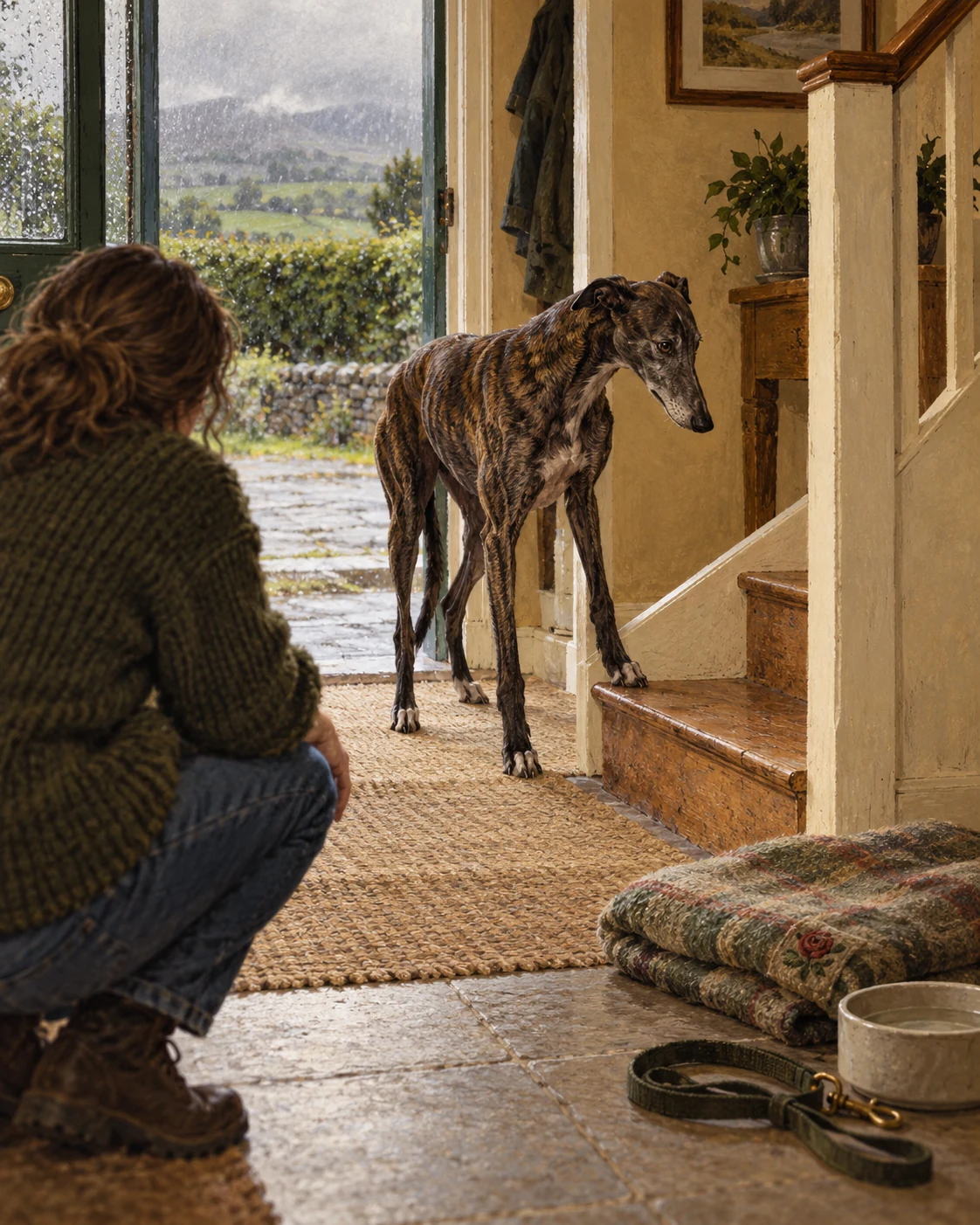
The first obstacle is often not a racetrack. It is a staircase. Homes for Unwanted Greyhounds says many retired racers entering foster care have never lived inside a house. Floors, windows, mirrors, television, traffic and the vacuum cleaner can all be new. Imagine surviving the back straight only to meet a Dyson. Life has a dry sense of humour.
HUG's volunteers make that strange little crossing possible. They arrange transport and veterinary visits, speak with trainers surrendering dogs, assess homes and answer the nervous questions that arrive with a long animal and a short instruction manual. Foster carers provide the half-way home. HUG says it covers food and veterinary costs and can supply bedding, bowls, leads, crates and coats. The volunteer provides time, patience and a floor that no longer feels like a trap.
Twenty million euro, then the kitchen floor
This week Ireland's Budget 2027 put €102 million into the Horse and Greyhound Racing Fund. Under the statutory 80:20 split, The Journal reports that greyhound racing will receive €20.4 million — its first allocation above €20 million since the fund began in 2001. Agriculture Minister Martin Heydon said the increase would be linked to implementing recommendations on welfare and integrity.
That is public money entering a commercial racing system with 15 venues, hospitality, betting and prize money. Greyhound Racing Ireland's own 2025 activity report records 14,889 races, 88,126 entries and €9.68 million in prize money. The industry has an engine, a regulator and a state-backed fuel line. At the quiet end of the same machine, a small volunteer crew is teaching a retired dog that a window is not an opening and a staircase is not a cliff.
HUG says it is run by a small team of volunteers and relies mainly on public donations. That does not prove it receives no grant or industry assistance, and this article does not make that claim. The point is narrower and harder to wriggle around: the State guarantees the racing structure a very large annual allocation, while the patient domestic work of retirement still depends heavily on people volunteering homes, transport and care.
What the industry's numbers say — and do not say
Greyhound Racing Ireland says the sport is well regulated and ethical. Its 2025 report says 95.55 per cent of welfare inspections were fully compliant, 99.63 per cent of race entries finished without a recorded injury, and the Irish Retired Greyhound Trust directly rehomed 592 dogs while assisting another 621. Those figures matter. The injury percentage is measured per race entry, however, not across a dog's whole life, and rehoming 1,213 dogs does not answer every question about every cohort.
In June, the Irish Examiner reported figures released through a parliamentary question: 5,960 greyhounds born in 2021 and 2022 were recorded dead among dogs classed as inactive, still in Ireland and not exported. The paper calculated this as 63 per cent of that defined group. GRI disputed comparing the two cohorts at different stages and said retirement-status changes can distort the proportion. It also said it was not aware of an underlying factor showing a sudden escalation.
We should be exact. The records do not establish why each dog died, and they do not show that racing caused every death. But they do establish a public-interest question far too large for a bookmaker's shrug: what becomes of thousands of dogs bred for a short commercial life, and why is independent lifetime traceability still being argued over after hundreds of millions in public support?
A halfway home is not a rounding error
The answer is not to romanticise rescue or demonise every trainer. Some trainers surrender dogs to HUG precisely because they want them placed well. Nor should anyone adopt a greyhound on a burst of Sunday outrage and discover by Tuesday that the sofa has filed for asylum. HUG uses home checks, careful matching and support after adoption for good reason.
The useful action is simple. If you are in Ireland and can offer a stable, suitable home for a transition period, read HUG's foster guide and apply through its official site. HUG says foster homes are always needed, especially beyond County Kerry. If fostering is not realistic, share that official page with somebody for whom it might be. Do not improvise a fundraiser or claim Rose Mission involvement. Support goes directly through HUG; The Rose Mission holds no funds and implies no partnership.
And the public-money question can be asked without foam around the mouth. Ring-fence transparent lifetime tracking. Publish like-for-like outcomes. Put retirement and independent rescue on the same serious footing as prize money and promotion. A country can enjoy tradition and still decide the dog is not disposable scenery. Enough is enough can sound remarkably gentle. Sometimes it is just a volunteer waiting beside the first stair.
I’ll leave you today with a line from Henry Beston, The Outermost House:“They are not underlings; they are other nations.”
Sources & ways to help
How to help: read HUG's foster guide and apply if suitable →Official Homes for Unwanted Greyhounds foster page, checked 12 October 2026. HUG says it is always seeking foster homes and sets out what it covers and what carers provide.
Read about HUG's volunteer work →Official organisation page describing HUG's purpose, volunteer structure, transport, veterinary and home-assessment work; checked 12 October 2026.
Read the Budget 2027 funding report →The Journal, 8 October 2026: €20.4 million for greyhound racing, the minister's welfare-and-integrity condition, and Greyhound Racing Ireland's response.
Read Greyhound Racing Ireland's 2025 activity report →Primary industry report published March 2026, including racing, prize-money, inspection, injury-entry and rehoming figures.
Read the reporting on the 2021 and 2022 dog cohorts →Irish Examiner, 3 June 2026, reporting parliamentary figures and Greyhound Racing Ireland's objection to the cohort comparison.
Verify the closing line in Henry Beston's The Outermost House →
Read another Irish story about volunteers carrying the cost →
Follow the thread