The Cost Nobody Prints · Croatia · illegal-waste remediation
The Ground Kept the Manifest.
In Gospić, residents kept asking where the waste went. The state now has a four-part remediation plan; the next test is whether every tonne leaves and every result becomes public.
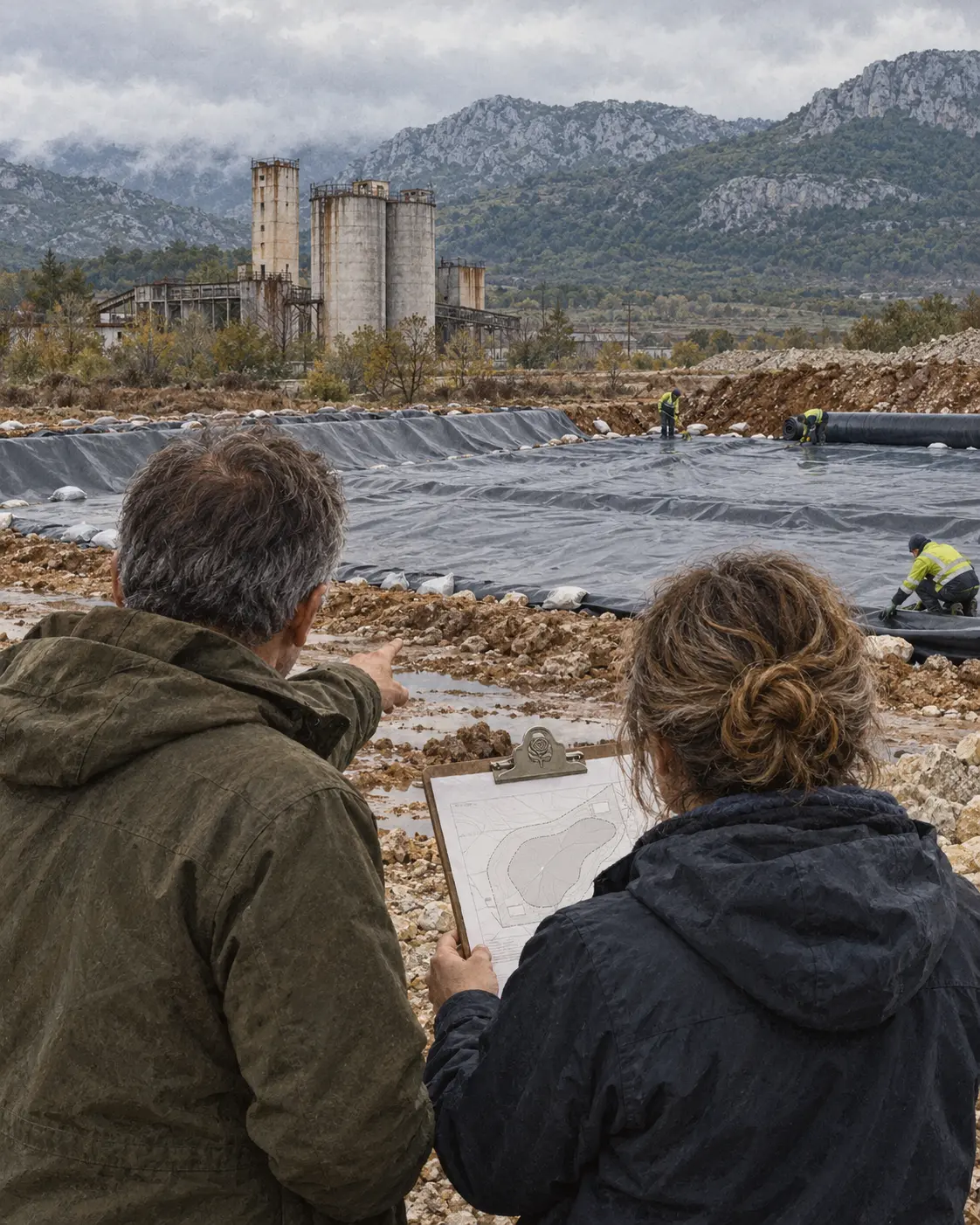
At the former PPK Velebit industrial site in Gospić, the first visible answer is a sheet of grey plastic. The Croatian Environment Fund says work is under way to cover the buried waste temporarily. The plan allows for about 20,000 square metres of LDPE membrane, intended to keep rain from driving more contamination through the ground while the main job is prepared. Sensible protection. Also, plainly, a lid—not a departure.
The ground underneath is carrying the sort of paperwork industry prefers to lose. For years, waste was improperly dumped and buried here. Residents organised as Gospić je naš dom—Gospić Is Our Home—and kept asking the unfashionable questions: what is in it, where did it come from, what has reached the water, who pays to remove it, and when does every last truck leave?
Four numbers, one site
The apparently conflicting tonnage now makes more sense. Early government material referred to roughly 35,000 tonnes of buried mixed waste. The detailed plan published in September separates about 4,500 tonnes scattered beside the silos, 650 tonnes in large bags, nearly 33,000 tonnes buried with soil and stone, and about 6,000 tonnes inside buildings and silos. Together, those streams come to roughly 44,000 tonnes. The residents' initiative rounds the whole mess to about 45,000. These remain estimates: the Fund says actual quantities and composition must be confirmed by surveying, weighing and characterisation.
That distinction matters. It is the difference between correcting a number and using confusion as fog. The fog has had a good innings. It can knock off now.
The cheap journey and the dear return
Faktograf traced the larger machinery. In 2023, 701,713 tonnes of waste entered Croatia under classifications that did not require prior notification. That trade was not automatically illegal. The weakness appears when a mixture is misclassified, when a plastic label hides other material, or when nobody can say where a load finally went. Croatian inspectors found 46 illegal cross-border shipments totalling 806 tonnes in 2023; the Gospić site shows what happens when the final destination becomes a hole in somebody else's town.
Croatia also has no landfill for hazardous waste. Material that cannot be properly recovered at home must go to suitable facilities elsewhere. The state plan therefore contemplates treatment or disposal outside the country for some fractions. Moving waste across a border is not the offence. Losing its identity, its treatment and its cost along the way is the danger. The invoice travels lightly. The ground gets the freight.
A plan is finally touching the ground
There has been movement. On 21 September the Fund said it had selected contractors to remove about 4,500 tonnes of scattered material beside the silos, after the first procurement attracted no acceptable offer. It also said a route had been secured for roughly 650 tonnes of non-hazardous waste in around 300 large bags. Temporary covering of the buried material was under way, with environmental and water monitoring continuing.
The heavier work is still ahead. The September plan put nearly 33,000 tonnes of buried waste into the most complex phase, with excavation, separation and characterisation proposed under controlled conditions. Another roughly 6,000 tonnes sits inside buildings and silos. The government says no phase should take longer than 13 months once it begins. As of 7 October, no public record reviewed by The Rose Mission verified how many tonnes had actually left the site. A contractor, a timetable and a membrane are progress. They are not a clean field.
Safe water is a result, not a lullaby
Government testing reported that the controlled public drinking-water supply was safe. Separate reporting found PFAS in waste and nearby groundwater, which is not the same thing as proving the town tap is unsafe. Both facts belong on the table. So do the missing ones: a complete public health-risk assessment, long-term soil and water trends, final disposal destinations, total cost and independently verified removal weights.
Gospić je naš dom carried seven demands into the Croatian Parliament's Environment Committee: urgent removal, clear deadlines and responsibilities, independent experts, full sampling data, long-term monitoring, a health and environmental risk assessment, and accountability. That is not panic. It is the maintenance manual a government should have written before the machinery swallowed a town's trust.
Keep the record in daylight
The useful action is modest and exact. Read the initiative's bilingual official page. Share its dated demands and the public remediation record, especially with people who can keep asking for weights, destinations, monitoring results and deadlines. Do not send money through an improvised appeal; no financial need or organisation-owned donation route was verified for this story. The Rose Mission holds no funds and claims no partnership.
A membrane can slow the rain. It cannot carry 44,000 tonnes away. That will take contracts, trucks, laboratories, lawful treatment and citizens stubborn enough to count what leaves. The residents have already done the hard spiritual bit: they refused to call buried trouble invisible.
I’ll leave you today with a line from William Shakespeare, The Merchant of Venice, Act 2, scene 2:“Truth will come to light.”
Sources & ways to help
How to help: read the residents' demands beside the 21 September state update →Official bilingual initiative page checked 10 October 2026. Its pre-remediation wording is not a current standalone status record; use it together with the linked Croatian Environment Fund update. Non-financial action; independent coverage, not a partnership.
Read the Environment Fund's 21 September contractor update →Primary record of the selected surface-waste contractor, the bagged-waste route, continuing monitoring and temporary-cover activity.
Read the Environment Fund's remediation overview →Primary description of the site, phases, estimated quantities, characterisation limits and monitoring plan.
Read the residents' seven demands in the Croatian Parliament record →Primary parliamentary record of the initiative's requests for removal, evidence, monitoring, independent review and accountability.
Read the independent investigation into the waste-trade machinery →Faktograf, 1 September 2026. It distinguishes lawful non-notified trade from misclassification, illegal shipments and final-destination failures.
Read the 22 September local report on the four-stage plan →Lika-Express reports the category estimates, costs, proposed treatment and stated implementation periods.
Verify the closing line at the Folger Shakespeare Library →
Read another story about residents turning contamination into a public record →
Follow the thread