Rose Ledger · Delivery workers · Algorithmic pay
The Delivery Arrived. The Pay Took the Scenic Route.
New York City’s $131.5 million DoorDash settlement shows what happens when workers, regulators and raw pay data force an algorithmic workplace to open its books.
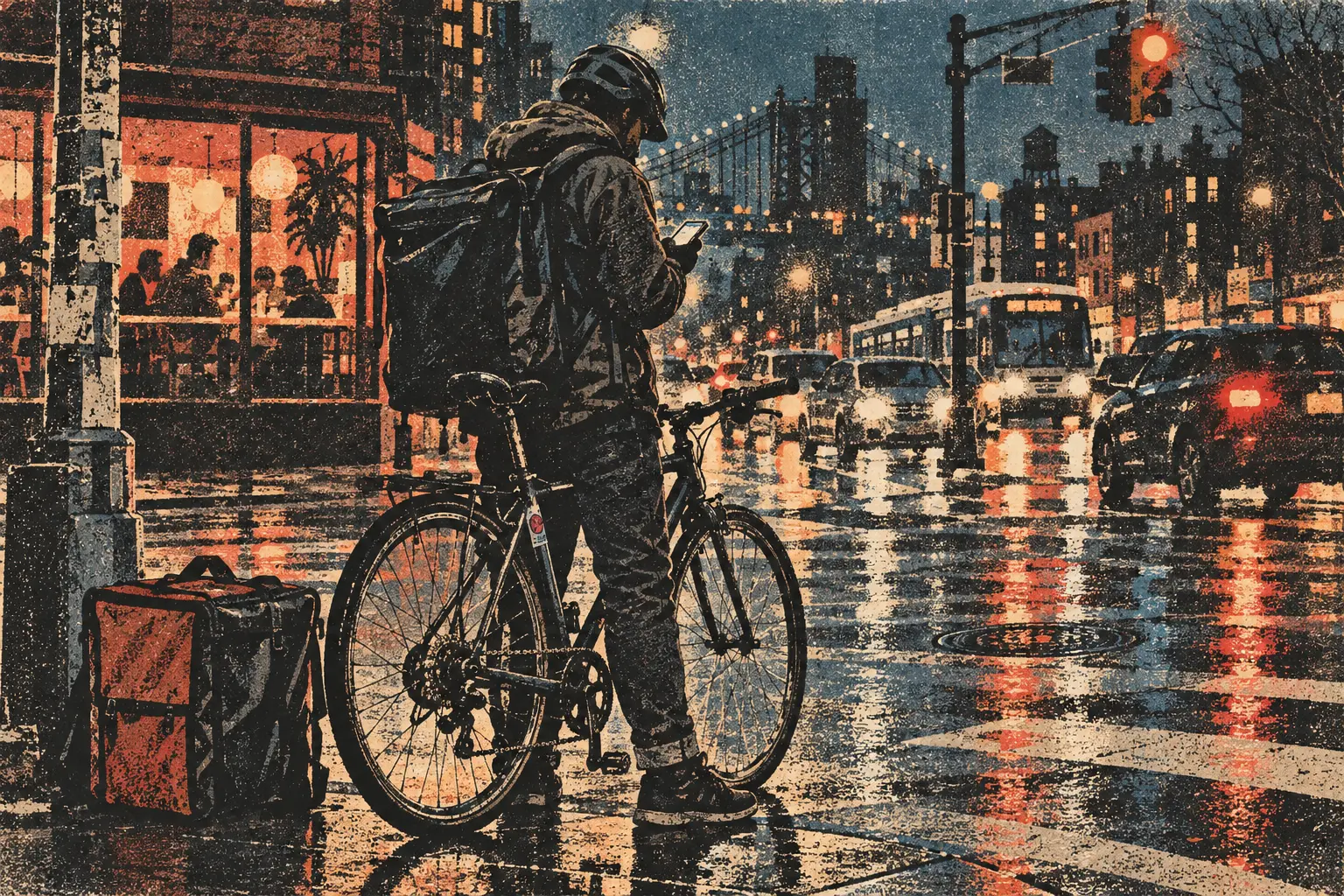
In New York, an entire workplace can fit behind one rectangle of glass. The phone offers the job, measures the journey, counts the minutes and announces the pay. The bicycle, rain and traffic remain stubbornly physical. The boss has become harder to point at.
On 22 September 2026, New York City pointed anyway. Its Department of Consumer and Worker Protection announced a $131.5 million settlement with DoorDash after an investigation into missing, late and undercalculated payments. More than $115 million is due to go to roughly 264,000 delivery workers. Another $16.7 million is civil penalties and costs.
This is not a story about an app developing a conscience. It is a story about workers keeping receipts until government finally opened the ledger.
The delivery was visible. The waiting time was not.
The largest part of the settlement—more than $83 million—concerns how pay was calculated while workers were logged into the app but between deliveries. The city says DoorDash excluded categories of trip and on-call time that should have counted under New York’s minimum-pay rule. A further $12.3 million addresses payments the city says were missing or arrived days or weeks late.
That distinction matters. A platform sees active delivery time, waiting time, route boundaries, cancellations and batched orders as fields in a system. A worker experiences all of them as Tuesday. The rain does not pause because the app calls the minute inactive.
DCWP says its analysts examined more than 152 million payment transactions and 110 million working hours. The investigation began after dozens of workers complained, many with help from Workers Justice Project. The machinery was enormous. The first useful movement came from people saying: the number on this screen does not match the work I did.
DoorDash answered. The answer belongs in the record.
DoorDash publicly apologised for underpaying or paying some workers late. It says many errors arose from technical bugs, cross-boundary deliveries, multiple stops, cancellations or incomplete banking information, and that less than one percent of payments were affected. It says those technical problems have been fixed.
The company disputes part of the city’s interpretation. DoorDash says workers were paid for online time but that it used a different method to calculate it, one the company considered fair and legal. It chose the settlement and the city’s method rather than years of litigation. DoorDash also says New York Dashers have earned more than $1 billion since the rule took effect and average roughly $30 per active hour before tips.
Those facts provide context; they do not erase the settlement. A payroll system can process a mountain of money and still fail the person missing one week’s rent. Scale is not a defence against accuracy. It is the reason accuracy needs independent proof.
The quiet heroes carried data, not capes
Los Deliveristas Unidos, organised through Workers Justice Project, has spent years turning scattered riders into a worker voice. Its members pushed for minimum pay, safer streets, tip transparency and the basic revolutionary concept that time spent under an employer’s digital control is still somebody’s life.
The settlement now creates a three-year compliance system with a rare sensible feature: workers help generate the evidence. DoorDash must provide monthly data to the city. Workers Justice Project and Princeton’s Workers’ Algorithm Observatory are due to develop software allowing workers to capture trip and earnings information and share it directly with regulators. DoorDash is prohibited from punishing workers for using it.
That is repair with a spanner in its hand. Not trust us. Show us.
What is not settled
A signed agreement is not three years of compliance. The worker-data tool is not yet a proven safeguard. The city declined to say whether Uber Eats and Grubhub comply with the same 2023 law. DoorDash says the relevant technical defects are fixed; the monitoring programme must now test that claim in the weather of ordinary work.
Payments are expected to begin this autumn. The city says eligible workers do not need to file a claim: personalised emails are due in late October to the last address used with DoorDash, with electronic payment or cheque available. A smaller second round is planned for early 2027 while additional calculation issues are corrected. Until money reaches workers, restitution is an obligation—not an outcome.
One useful action
If you delivered for DoorDash in New York City between 22 April 2022 and 28 June 2026, use the city’s official settlement page, check the email address you last gave DoorDash and use the city hotline when it opens at the end of September if your contact details changed. Do not pay anybody to file a claim for you; the city says no claim is required.
Elsewhere, keep your own record of logged-in time, jobs, distance, tips and payments before an app updates the screen. If something is wrong, use the regulator or worker organisation where you live. A screenshot is a small thing. So was the first loose bolt before the wheel came off.
Know a courier collective, worker centre or small team making invisible labour visible? Nominate it for The Rose Mission with a public source and permission. The people who delivered the evidence deserve at least as much attention as the company delivering dinner.
Convenience is not weightless. Somebody waits at the crossing, carries the bag and watches the phone decide what the hour was worth. The least a modern city can do is make the machine show its working—and believe the worker when the arithmetic smells wrong.
I’ll leave you today with a line from Florence Reece, Which Side Are You On?:“Which side are you on?”
Sources & ways to help
Read New York City’s settlement announcement →Published 22 September 2026; includes the city’s findings, payment process and three-year monitoring plan.
Read Reuters’ independent report →Published 22 September 2026; includes the settlement figures, DoorDash’s response and limits on what is known about other platforms.
Read DoorDash’s full response →Published 22 September 2026; the company acknowledges errors, explains its position on online-time pay and sets out its proposed fixes.
Meet Los Deliveristas Unidos →The official worker-led page explains its organising, research and New York contact routes. The Rose Mission receives no money and claims no partnership.
Follow the thread