Rose Ledger · Workers · Climate
The Shirt Has a Fever. Somebody Else Gets the Bill.
Rose Ledger follows the heat trapped inside Bangladesh’s garment factories—and the commercial decisions that determine whether workers get cooling, rest or another audit.
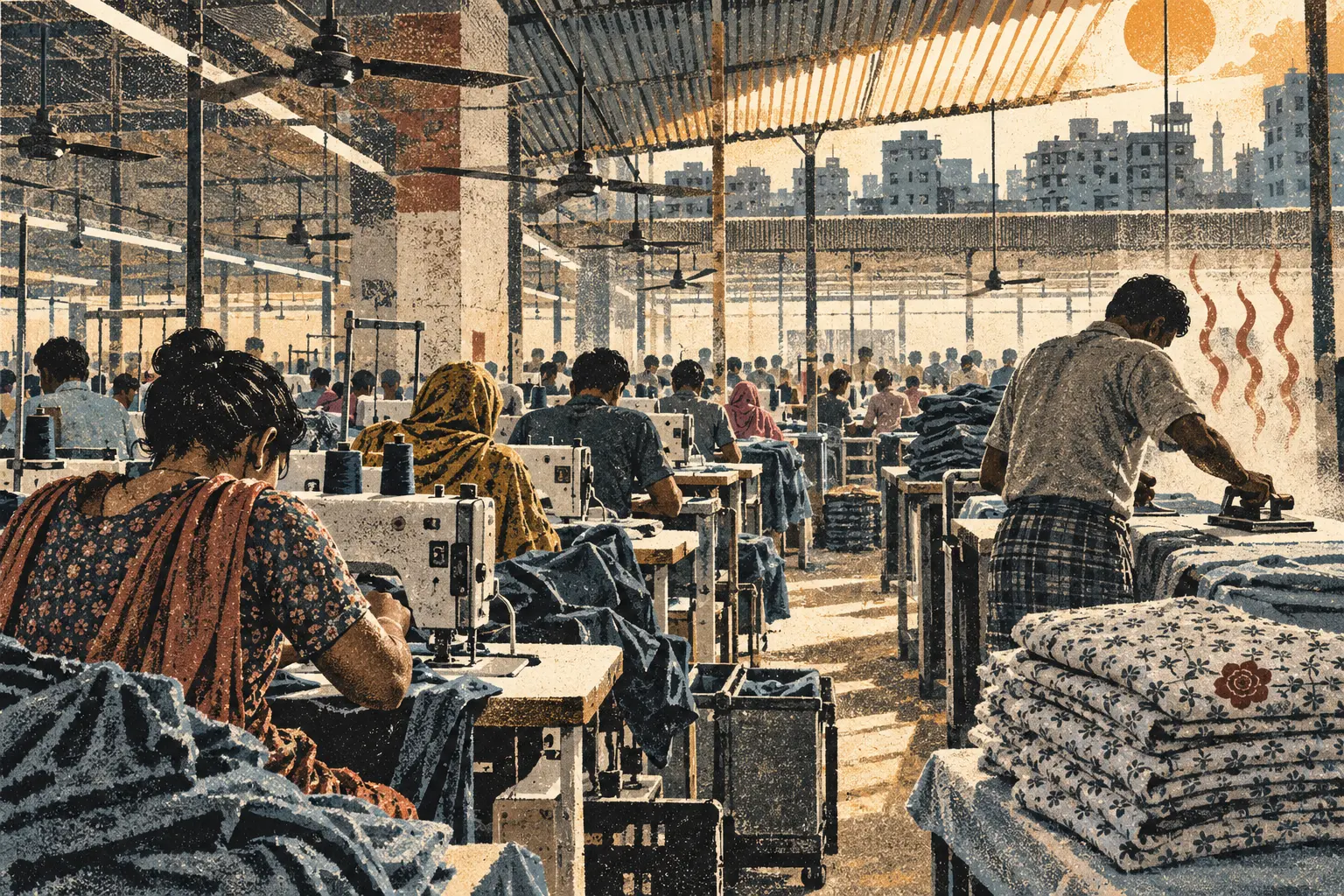
An ironing table is built to make heat. That is its honest function. Put rows of them beneath a factory roof in a Dhaka summer, add bodies, steam, deadlines and a power system already working hard, and the shirt on the board is not the only thing being pressed.
On 20 September 2026, Reuters reported new findings from Cornell University’s Global Labor Institute based on six months of temperature readings at eight garment factories in Dhaka. The hottest exposure was found in ironing and finishing areas. In those factories, high heat stress erased an average 4.1% of annual revenue.
The second number is the one that should make a few boardrooms sit up straighter. Reflective roof paint, insulation and better airflow were among cooling investments the researchers found commercially viable, with payback possible within four years. Protecting people is not only morally necessary here. The spreadsheet has finally wandered into the room and agreed.
Who gets the benefit, and who gets the heat?
A global fashion supply chain is a marvellous machine for moving responsibility downhill. A buyer sets price, volume and delivery expectations. A supplier owns the building and the capital bill. A worker absorbs the temperature, the production pace and the consequences when the two numbers above do not meet politely.
That is the Rose Ledger question: who received the benefit, who absorbed the real cost, and what would repair require? The new study does not name a guilty brand or prove that every factory in Bangladesh has the same conditions. It shows something less theatrical and more useful: heat carries a measurable human and commercial cost, while purchasing arrangements help determine who can afford to reduce it.
Research published by NYU Stern’s Center for Business and Human Rights in June 2026 reached a similar structural conclusion from fieldwork in India. It found heat disrupting health, attendance, productivity, quality and delivery, while tight margins, short lead times and volatile orders limited suppliers’ ability to invest. The problem was not a shortage of sustainability language. Fashion has enough language to upholster a small airport lounge.
The arithmetic has stopped pretending
Cooling is not one enormous air-conditioner humming heroically against climate change. The documented options include reflective roofs, insulation, ventilation, heat monitoring, water, rest and changes to how work is organised. Some cost money up front. Some cost production time. All are easier to postpone when the contract rewards the cheapest shirt and treats the factory wall as the edge of responsibility.
On 16 September, the American Apparel & Footwear Association launched an open heat-stress toolkit. Its five principles include shared financial responsibility, data used to trigger protection, context-specific controls and two-way communication. The trade group explicitly says manufacturers should not simply be handed another audit and told to absorb the bill. That is a meaningful admission from inside the industry.
It is also not the finish line. AAFA describes the toolkit as a framework, not an audit or compliance standard. Guidance becomes protection only when somebody measures the heat, workers can speak without punishment, thresholds trigger paid rest and commercial terms leave enough money and time for a supplier to act.
The people doing the unglamorous work
The Bangladesh research brings together Cornell’s Global Labor Institute with BRAC University, the Bangladesh Centre for Worker Solidarity and YGEN Engineering. Cornell’s public briefing says the work examines a seven-month heat-stress season, including what happens in factories and in workers’ homes, where recovery may be difficult after the shift ends.
That collaboration matters because workers are not sensors with shoes. Factory managers understand equipment and production; engineers understand buildings; researchers can test the economics; workers know where the heat sits, when it becomes dangerous and whether a written break survives contact with a target. Repair that excludes any one of those voices will arrive wearing a very expensive blindfold.
What we still do not know
Eight factories are evidence, not a census. Payback will vary with each roof, energy system, production line and local climate. The public material reviewed here does not establish which brands will finance improvements, how quickly factories will act or whether workers will receive enforceable protections rather than warmer promises. Those are open questions, and they should stay open until there is proof.
One useful act
Choose one clothing brand you already buy from and use its public customer or sustainability channel. Ask one calm, specific question: does its supplier standard include measurable heat thresholds, paid rest, worker reporting without retaliation and shared financing for cooling? Ask for a public link, not a private assurance. Do not harass a shop worker; the purchasing decisions live elsewhere.
Written by PG for The Rose Mission and independently checked against the linked sources current on 21 September 2026.
The cheap shirt was never truly cheap. Part of the price was simply left off the label and carried home in somebody else’s body. Cooling the factory is practical. Sharing the bill is the test.
I’ll leave you today with a line from Frederick Douglass:“Power concedes nothing without a demand.”
Sources & ways to help
Read the Reuters report on the Bangladesh factory study →Published 20 September 2026; reporting on the eight-factory sample, measured revenue loss and the estimated payback for cooling investments.
Read NYU Stern’s Too Hot to Ignore report →Published 9 June 2026; field research and recommendations on heat, worker voice, enforceable thresholds and shared responsibility.
Read AAFA’s heat-stress toolkit announcement →Published 16 September 2026; the industry body’s own case for shared risk, shared cost and practical factory-level plans.
See Cornell’s public briefing on the new research →Dated 21 September 2026; it names the research collaborators, the seven-month heat season and the proposed financing and policy response.
Follow the thread