Rose Ledger · Carbon markets · Rural communities
A Forest on Paper. An Empty Shearing Shed.
New Zealand’s carbon market can turn working farms into pine credits while harder emissions cuts wait. The trees are real. So are the people and places disappearing from the ledger.
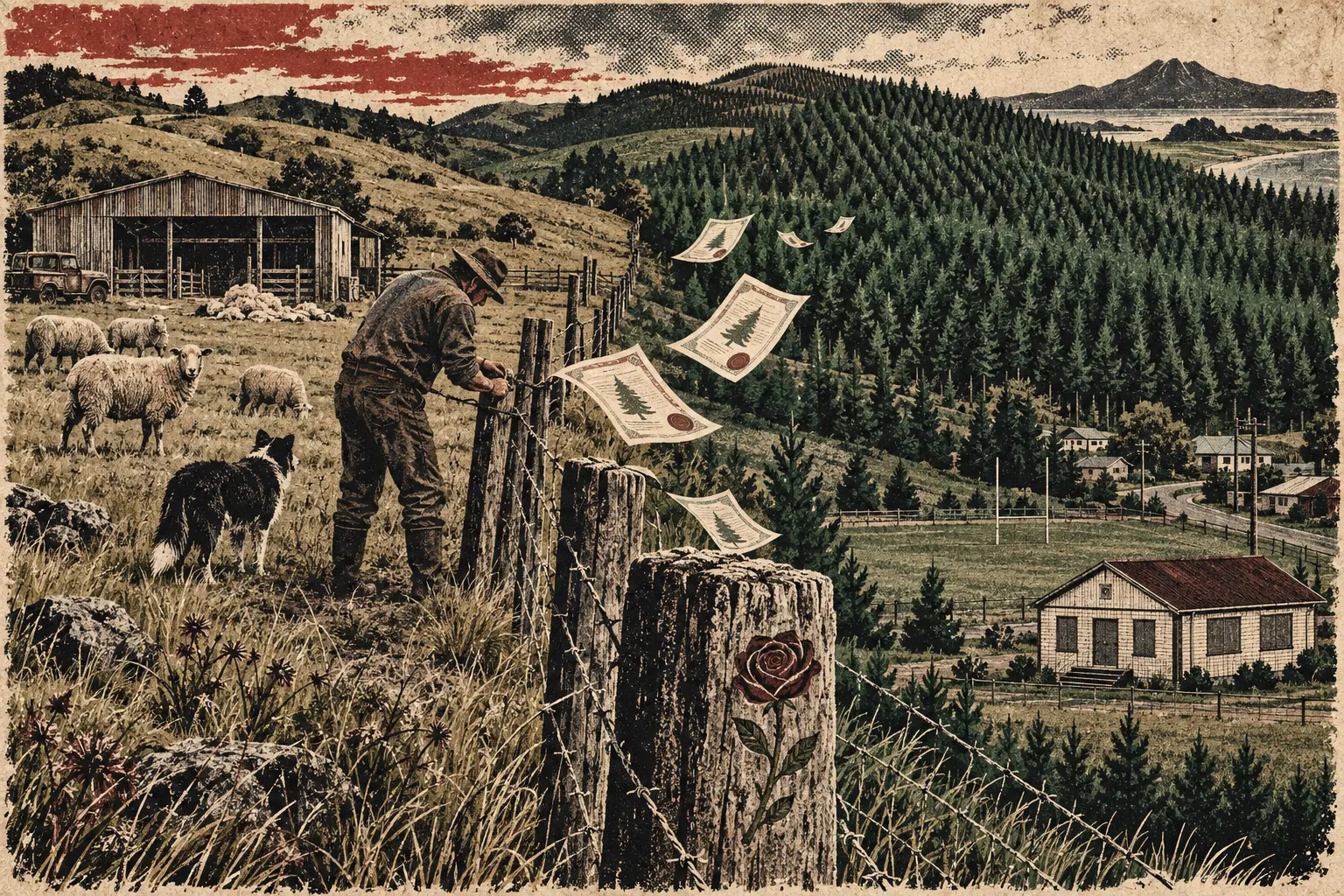
At lambing time near Pongaroa, on New Zealand’s North Island, Fiona Ramsden can look across pasture, sheep and a century-old farmhouse. Reuters reported on 21 September that nearly every other direction now ends in young radiata pine. The trees stand on land that once carried sheep and cattle. They are growing timber, carbon credits and a very awkward question.
What is a climate policy worth if the certificate stays green while the village grows thinner?
Ramsden told Reuters that goats and pigs move from neighbouring forest onto her farm, gorse spills towards fences and trees are pressing against power lines. These are her observations, not a national verdict on forestry. But the mechanism around her is documented: under New Zealand’s Emissions Trading Scheme, eligible forests earn tradable units as they absorb carbon. Companies with covered emissions can buy units. A tree begins doing two jobs—storing carbon in the landscape and carrying permission through the market.
The Rose Ledger: who banks the credit?
Since 2017, about 3,300 square kilometres of sheep and beef land have been sold for forestry conversion, according to Beef + Lamb New Zealand data cited by Reuters. Government records show foreign investors acquired more than 1,000 square kilometres for conversion in that period. Ingka Investments—the investment arm linked to most IKEA stores—owns 430 square kilometres of New Zealand forest, some inside the ETS.
That does not prove a conspiracy, or even one common motive. Ingka told Reuters that timber, not carbon-credit income, is the core of its investment. A farmer who sells at a strong price may make a rational choice. Iwi, family farms and companies can all earn forestry units. Forestry itself supports jobs and roughly NZ$6.5 billion in annual exports, according to the Forest Owners Association, whose chief executive rejected the claim that the sector hollows out regions.
The ledger still has a missing column. A grazing farm supports shearers, contractors, stock agents, truck drivers and families. Reuters found that Pongaroa’s rugby club folded in 2022 and its community-run daycare closed in 2023 as enrolment fell. The wider Owahanga area’s population declined an estimated 2.6% over a decade, continuing a longer rural slide. Carbon forestry did not invent every pressure on country towns. It can accelerate one: fewer animals, fewer shifts, fewer households buying groceries and pulling on boots for Saturday sport.
At a Hawke’s Bay shearing shed, Brandon Coombe-Gray described one former 10,000-ewe station now entirely in pine. Shearer Axle Reid said rising land prices had pushed his hope of buying a farm further away. These are not people standing in the path of climate action. They are people asking why its costs keep arriving at their gate while the credit travels elsewhere.
The policy made the market
New Zealand’s ETS rewards fast-growing forest because carbon is counted as trees grow. The Climate Change Commission expects ETS forests to provide a quarter of the reductions needed for the country’s 2026–2030 target and nearly half for 2031–2035. Its chief executive, Jo Hendy, told Reuters the system is effectively functioning as an offsetting scheme. That matters because a cheap unit can postpone the less photogenic work: changing industrial equipment, fuel, transport and energy systems so they emit less in the first place.
Agriculture is not wearing a halo here. It produces just over half of New Zealand’s greenhouse-gas emissions, mainly methane and nitrous oxide, and those agricultural emissions sit outside the ETS. Nor are pine trees villains in little green uniforms. Properly managed production forests store carbon, supply timber and employ people. The problem is an incentive that can reward blanket conversion more reliably than mixed land use, native restoration or direct pollution cuts.
Parliament acknowledged part of that problem. The Climate Change Response (Emissions Trading Scheme—Forestry Conversion) Amendment Act received royal assent on 22 September 2025, limiting some whole-farm exotic-forestry registrations. Reuters reported that wholesale conversions slowed in preliminary 2026 data. Slower is not solved, and the rules do not answer how rural communities share in the value created around them.
A better forest is not a loophole with leaves
Repair does not require choosing between a liveable climate and a living town. It requires doing both jobs honestly. Cut gross emissions. Keep productive farming where it makes sense. Put native regeneration on erosion-prone slopes, stream edges and other land where it can strengthen biodiversity and water as well as store carbon. Pay landowners and communities for verified outcomes without pretending one hectare excuses unlimited smoke somewhere else.
There is practical work under way. In May, state-owned farmer Pāmu and the not-for-profit True Nature announced plans to explore native restoration on less productive or vulnerable land. The model builds on Trees That Count and is designed to group smaller sites so administrative costs do not shut out farm-scale projects. It is early, not proof of delivered outcomes, but it shows another route: restoration beside farming rather than a financial crop swallowing the whole map.
One useful action
If your employer, bank, airline or favourite brand claims carbon neutrality, ask for two numbers separately: gross emissions cut, and credits bought. Then ask what kind of forest produced the credits, how long the carbon must remain stored, whether local and Māori rights were respected, and what happened to jobs and biodiversity. New Zealand’s Ministry for the Environment now lists six plain integrity tests: additional, durable, real and measurable, transparent, respectful of rights, and not double-counted. A glossy forest photograph is not a seventh test.
For people in Aotearoa who can contribute practical restoration work, Trees That Count maintains a current route for community planters. Check the project and location before joining; the point is useful local work, not another selfie with a seedling.
Know a rural worker, native-restoration crew or small community project doing this well? Nominate them for The Rose Mission with a public source and their permission. The people repairing the ledger deserve more attention than the certificate.
Trees belong in the climate answer. So do honest emissions cuts, working landscapes and the people who keep a place alive after the investors have gone home. Leave any one of them out and the accounting may balance while the country does not.
I’ll leave you today with a line from Aldo Leopold, A Sand County Almanac:“The land ethic simply enlarges the boundaries of the community.”
Sources & ways to help
Read Reuters’ report from Pongaroa →
See the New Zealand Parliament record →
Read about the Pāmu–True Nature restoration model →
Use New Zealand’s official carbon-market integrity principles →
Follow the thread