The Cost Nobody Prints · Indonesia · nickel, water and land defenders
The River Did Not Sign the Permit.
In Indonesia's Central Halmahera, Sagea-Kiya residents are defending karst water while Cultural Survival reports that fourteen people face a mining-related investigation and the permits remain outside public view.
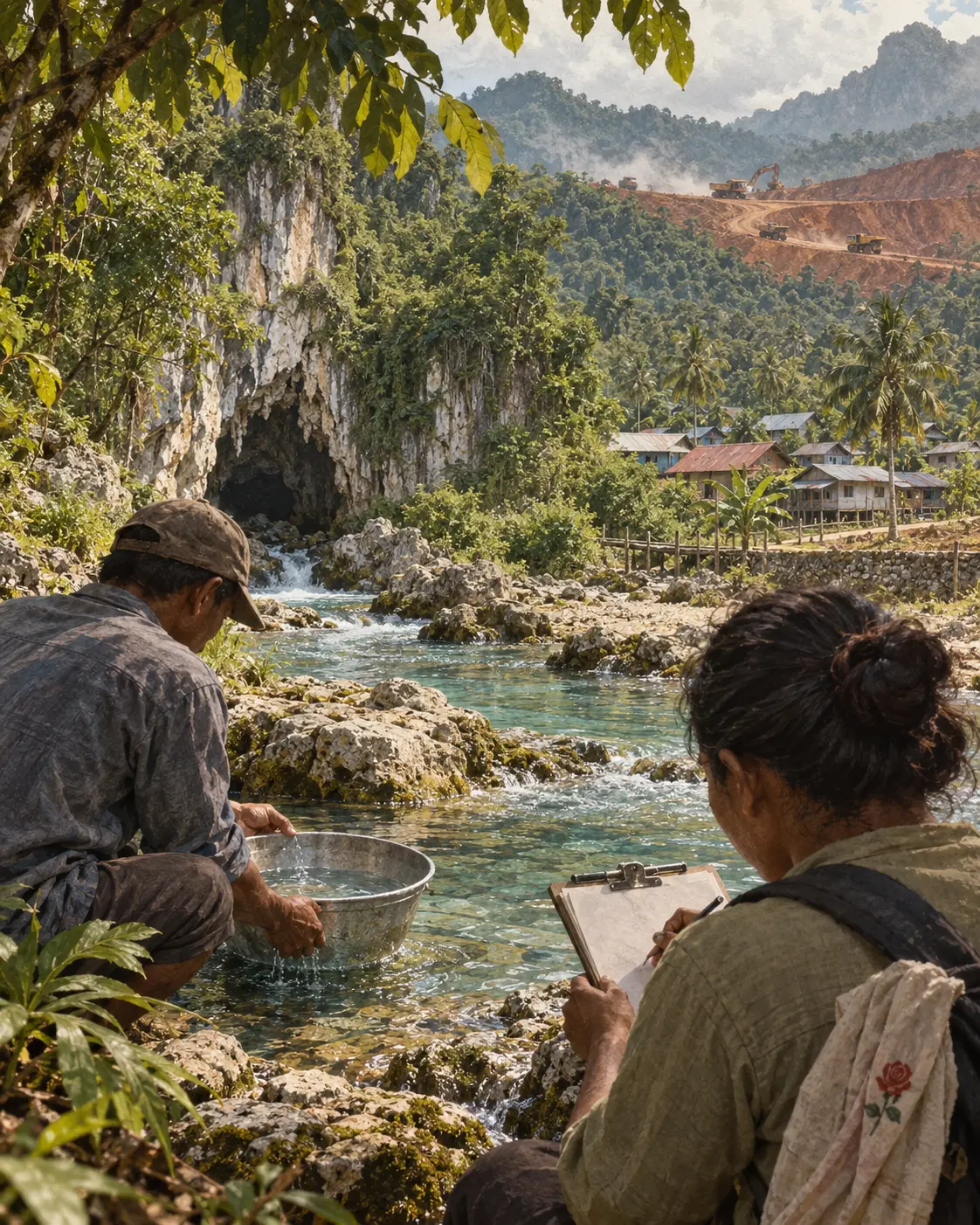
In Sagea, on the Indonesian island of Halmahera, water comes out of limestone country. Boki Moruru cave feeds the Sagea River. Nearby lakes hold fish and drinking water when the sea turns rough. Karst does quiet engineering: it stores rain, releases it slowly and sends no invoice. This is apparently an inefficient business model, because nobody has yet found a way to put it on a barge.
The people of Sagea and Kiya do understand the balance sheet. They drink the water. They fish the lakes. They know what sits uphill. Through the local Save Sagea coalition, residents have opposed nickel operations around their villages and asked to see the permits and assessments behind them. In February 2026 they put a protest tent near a company jetty. Cultural Survival reports that fourteen residents later entered a police investigation.
Fourteen names beside one article of law
Recent reporting by an Indigenous Journalism Fellow for Cultural Survival cites a police report, an inquiry order and a Notice of Commencement of Investigation sent to the North Maluku High Prosecutor's Office on 26 February. The notice links the case to Article 162 of Indonesia's Mineral and Coal Mining Law, which can be used against people accused of obstructing licensed mining activity. The residents were questioned as witnesses. As of 1 October, the reporting said it remained unclear whether any would become suspects. No reviewed source establishes a conviction.
That legal distinction matters. So does the human one. A summons is paper, but it can colonise a kitchen table. One resident described unknown callers ringing for hours after the case began. Another family said the questioning disrupted preparations for a wedding. Those are their reported experiences, not scenery for us to decorate. The useful fact is plain enough: ordinary people defending ordinary water are carrying extraordinary uncertainty.
The company disputes the story
PT Mining Abadi Indonesia, described in current reporting as the operator or contractor working at the site, published a right of reply on 7 February. Its representative said the company held an approved work plan, a jetty permit and a forest-area permit; offered annual community-development money; and viewed protesters' payment demands as extortion. The company said the tent blocked its work road and a provincial road, and alleged that workers removing it were assaulted. Those allegations have not been tested here. They belong beside the residents' account, not underneath it in tiny type.
Save Sagea's statement says the coalition rejected an 11 February agreement reached with village and subdistrict authorities because one clause declared support for mining and promised no disruption. The coalition says it did not consent. It is asking the company to withdraw the police complaint and asking government authorities to review and revoke the mining licences. The company says its permissions are complete. The public sources reviewed for this article did not include the underlying permit files, maps or environmental assessments. Their validity and exact footprint therefore remain unresolved here.
The cheap metal and the expensive silence
Nickel is useful. It goes into stainless steel and some batteries. But usefulness is not a moral solvent. The mechanism in Sagea is concrete: mining rights and operating approvals make extraction possible; barges carry ore away; Article 162 gives licensed operators a legal tool when opposition interrupts work. The local water system, meanwhile, has no compliance department and no barrister. It only has the people who notice when the hillside changes colour.
The reviewed evidence does not identify the exact downstream buyer of ore from this operation. It would be lazy to point at a particular car, battery or country without that chain. What the record does show is a local contest over water, land, consultation and the right to object while nickel leaves by boat. The benefit moves outward. Much of the risk stays put. That is the cost nobody prints on the metal.
One useful act
Read the coalition's own statement on JATAM's site and share that official record together with the company's published response. Keep the names of the community and the unresolved legal status attached. Do not improvise a fundraiser, contact residents on their private numbers or claim a partnership. No verified donation request is made here. The Rose Mission holds no funds and has not contacted or represented the coalition.
A fair process would put the permits, environmental conditions, maps and monitoring in daylight; allow the community to challenge them without fear; and test any alleged violence under ordinary law rather than treating a mining licence as a muzzle. Enough is enough does not need a megaphone. Sometimes it is two words said calmly beside a river that has been doing its job for longer than any company registry.
I’ll leave you today with a line from Henry David Thoreau, Walking:“In Wildness is the preservation of the World.”
Sources & ways to help
How to help: read and share the Save Sagea coalition statement →Coalition statement hosted by JATAM, published 22 February 2026 and checked 10 October 2026. Its embedded statement carries an apparently inconsistent 21 February 2025 dateline, so the chronology is treated cautiously. Non-financial action; independent coverage, not a partnership.
Read the legal-case report →Cultural Survival Indigenous Journalism Fellow report, 22 September 2026, citing the police-report, inquiry-order and investigation-notice numbers and recording the legal team's account.
Read the residents' current accounts →Follow-up reporting published 1 October 2026. Claims about threats, consultation, water risk and community payments remain attributed to the speakers.
Read PT Mining Abadi Indonesia's response →Company right of reply published 7 February 2026, setting out its permit claims, community-payment offer and account of the protest.
Read Indonesia's Mineral and Coal Mining Law record →Official Indonesian Audit Board legal database entry for Law No. 3 of 2020, including its status and later amendments.
Verify the closing line in Thoreau's Walking →
Read another story about extraction, maps and community consent →
Follow the thread