The Cost Nobody Prints · Colombia · water defenders and copper
The Flowers Need Water. The Mine Still Needs a Licence.
In Colombia's western Andes, eleven farmers face trial after resisting work linked to a proposed copper mine. Their water, land and right to speak are all still on the docket.
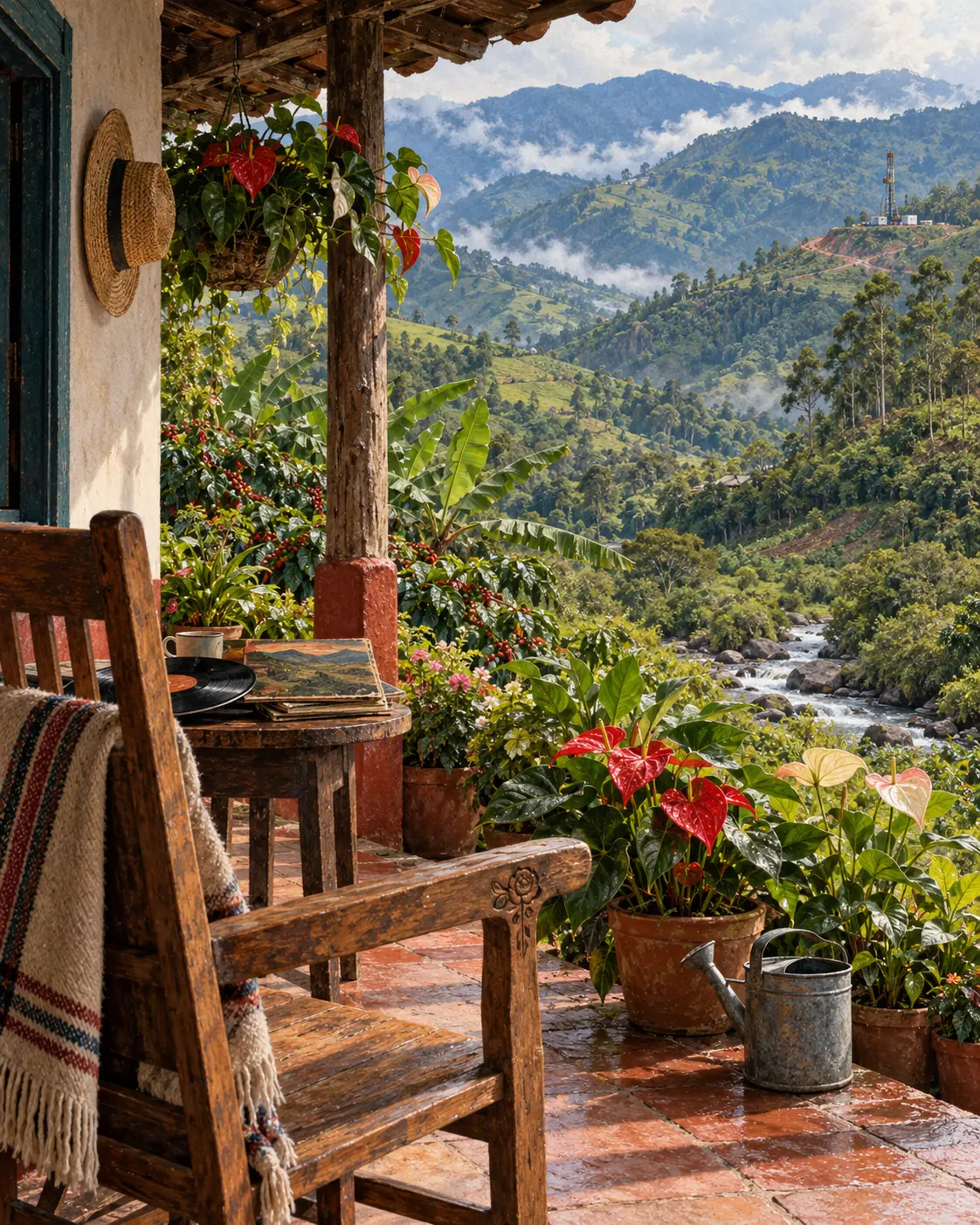
On a porch in Palo Cabildo, high in Colombia's western Andes, a small sign says yes to water. Porfirio Garcés tends anthuriums, keeps a vinyl collection and, at 87, waits for a criminal case to move again. The flowerpots are modest. The machinery proposed for the mountain is not.
Garcés is one of the Jericó 11: farmers and community leaders charged after confronting exploration work connected to AngloGold Ashanti's proposed Quebradona copper mine. The accusation hearing planned for August 2026 was postponed to March 2027. El Colombiano reported that the delay followed a prosecution request for a restorative-justice opinion and the court's trouble with its internet, audio and video equipment. Eleven people carrying serious charges while a courtroom searches for a working cable. Institutional comedy is rarely funny to the people living inside it.
A project can wait. A person still ages
The legal machinery is not the same as a verdict. Prosecutors allege simple kidnapping, aggravated theft and personal injury over events in 2022 and 2023. The farmers deny criminal wrongdoing. They say workers and machinery entered land or sites connected with community water protection and that they halted work, called authorities and delivered dismantled equipment to police. Employees complained that they had been held against their will. Those competing accounts belong in court, not in a slogan pretending the facts are already settled.
Colombia's Defensoría del Pueblo has asked the courts to examine the case in its wider environmental-conflict context. In May 2025 it said decisions should be proportionate and should respect the right to defend a healthy environment. It did not declare the accused innocent. It said the state must not treat environmental defence as an inconvenience to be tidied away with the criminal code.
The licence that was not there
Quebradona is not an operating mine. In October 2021 Colombia's environmental licensing authority, ANLA, archived the environmental-licence application because the record did not support a final decision. Its list was not a missing staple or two. It included the area of influence, hydrogeology, hydrology, geotechnics, biodiversity, tailings and subsidence. The company could submit new studies, but extraction could not simply begin.
The mining title and the environmental licence are different gates. On 19 August 2026 the National Mining Agency extended Quebradona's exploration stage to 8 December 2027 so geological, environmental and water studies could continue. The agency framed the decision around responsible investment, employment and cooperation with private mining companies. For the residents, it meant more exploration in a territory whose water questions were still open. Both statements can be true. That is precisely why the gate matters.
Who carries the risk before copper leaves the ground?
In June 2025 the Colombian government created a temporary natural-resources reserve across parts of southwest Antioquia. AngloGold says the measure blocks new environmental permits for three years, possibly five, while respecting existing concessions. The company has challenged it in court and recorded a US$98 million impairment against Quebradona exploration and valuation costs. That is a disclosed corporate cost. The farmers' cost arrives differently: postponed hearings, divided neighbours, time away from coffee, plantains and community water boards, and the quiet pressure of being called defendants into old age.
AngloGold told the Guardian that Quebradona complies with Colombian law, does not threaten local water sources and is supported by studies showing no groundwater or surface-water impact. It described the activists' actions as illegal and disruptive, said it filed criminal complaints, and pointed to dialogue, transparency and a biodiversity-restoration initiative. Those are material responses. They do not erase ANLA's technical gaps, the unresolved trial or the basic democratic question: how much uncertainty should a farming district be required to carry for somebody else's future copper?
A useful act, without borrowing the farmers' courage
On 31 August, Cinturón Occidental Ambiental published a declaration signed by 281 water boards, community councils, environmental groups and other organisations. They rejected two more years of exploration and asked that the region's water and agricultural life come before the project. COA is not a scenery department for an international campaign. It is a regional coalition describing its own ground in its own language.
The practical action is to read that declaration and share the official community record alongside the regulator's and company's positions. No donation request was verified for this story. The Rose Mission holds no funds and claims no partnership. Useful solidarity begins by sending attention to the people doing the work, then leaving their voice attached.
Copper may be useful. So are coffee, cassava, clean streams and the right to object without spending the far end of a life under accusation. A mine can submit another study. An 87-year-old farmer cannot apply for an extension on time.
I’ll leave you today with a line from William Shakespeare, As You Like It, Act 2, scene 1:“Books in the running brooks.”
Sources & ways to help
How to help: read and share COA's community declaration →Official coalition record published 31 August 2026 and checked 8 October 2026. Non-financial action; independent coverage, not a partnership.
Read ANLA's environmental-licence archive decision →Primary regulator record, 25 October 2021, listing the technical information gaps that prevented a final licensing decision.
Read the National Mining Agency's exploration extension →Primary record, 19 August 2026, extending exploration to 8 December 2027 and requiring further geological, environmental and water studies.
Read the Colombian ombudsman's position →Primary public statement, 25 May 2025, asking courts to consider proportionality, environmental-defender protections and the wider conflict.
Read AngloGold Ashanti's current Quebradona status →Company account of the temporary reserve, its legal challenge and the US$98 million impairment.
Read the independent report and the company's detailed response →Guardian reporting from Jericó, published 1 October and updated 6 October 2026.
Read the local report on the postponed hearing →El Colombiano, 29 July 2026, reporting the prosecution request, courtroom technical failure and March 2027 date.
Verify the closing line at the Folger Shakespeare Library →
Read another South American story about community consent and extraction →
Follow the thread