The Cost Nobody Prints · Kenya · Raptors and power infrastructure
The Pole Was Cheap. The Wings Were Not.
Kenya’s raptor carers are treating birds burned by unsafe power infrastructure while a retrofit pilot tests the repair. Here is one direct way to help.
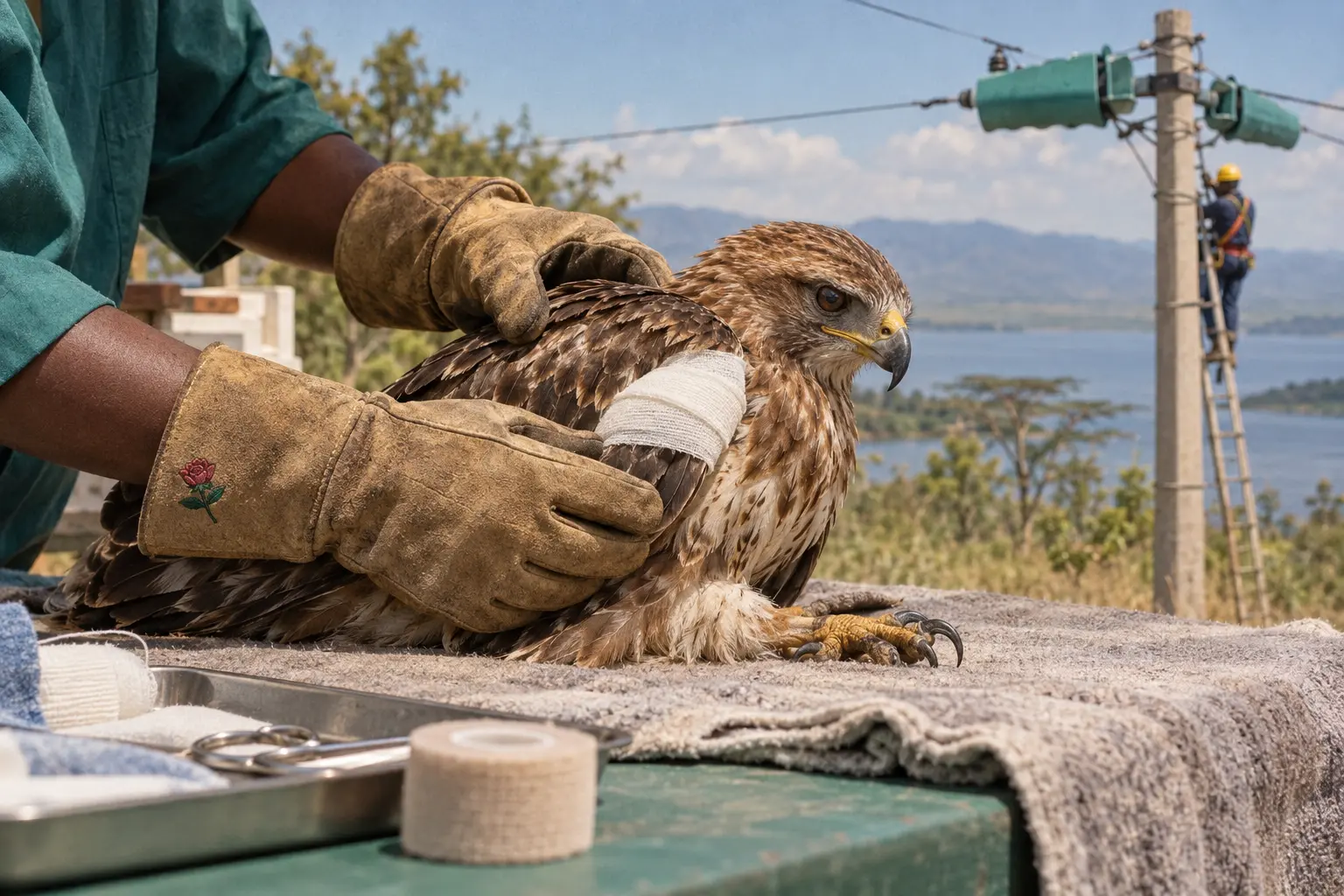
On the Kenya Bird of Prey Trust’s treatment page, a burned foot is wrapped in gel gauze. Antibiotics follow. The damaged limb is massaged to keep blood moving. Then everyone waits to learn whether a raptor will fly again—or lose the wing or foot it needs to hunt.
The bird did not make a poor decision. It saw a pole: height, horizon, a sensible place to perch. The poor decision was ours.
A perch wired like a trap
The Trust says concrete distribution poles with exposed metal reinforcement can complete a circuit when a perched bird touches live equipment. Some birds die on the pole. Others fly away with injuries that worsen over days. The centre at Naivasha says many electrocution survivors reach its care; its current accommodation is built for about 40 birds, including animals that cannot return to the wild.
That account sits inside a much larger collapse. A peer-reviewed study published in Biological Conservation in 2022 compared Kenyan road surveys from 1970–1977 with surveys from 2003–2020. Encounter rates fell for 19 of the 22 raptor species examined. Among species with a significant or near-significant change, the median fall was 70 per cent. The authors identified electrocution and collision with energy infrastructure among the threats, alongside poisoning, persecution and habitat loss.
Kenya’s national vulture action plan also lists collision and electrocution on power lines. This is not a tale about one wicked pole or one careless linesman. It is a design problem repeated across a network, then delivered feather-first to a small treatment room. Procurement paperwork is wonderfully light. A burned eagle is not.
The repair has begun. The proof has not arrived.
There is a fair and important response. On 18 June 2026, Kenya Power announced a five-year wildlife-protection project with Kaddas Enterprises. It began at Soysambu Conservancy, retrofitting protective covers on high-risk sections of power line and training technical staff. Kenya Power also made the business case: fewer wildlife contacts should mean fewer outages and better reliability.
Good. A safer grid should not need to choose between electricity and wings. But a pilot is a beginning, not absolution with cable ties. Kenya Power’s public announcement does not yet provide before-and-after bird mortality, the number of poles retrofitted or a national rollout timetable. Those are the figures that will show whether the repair is moving faster than the harm.
The quiet question is difficult to dodge: once a known design can be made safer, how many more birds should carry the cost of waiting?
Help the hands doing today’s work
While engineers test covers and institutions count years, the Kenya Bird of Prey Trust’s carers still feed birds, clean enclosures, dress wounds and make the hard call about release. Their work does not cancel the need for safer infrastructure. It keeps an injured animal alive long enough to have a chance.
One concrete action: use the Trust’s official Adopt a Raptor page. It starts at US$5 a month and says the money supports food, enclosure maintenance, enrichment, medical care and staff. Choose only what you can afford. If money is tight, share the Trust’s own explanation with somebody who cares about birds or power-system design. The Rose Mission holds no funds, takes no commission and makes no claim of partnership.
A raptor belongs above the wires, reading the country on its own terms. The least our machinery can do is stop punishing it for landing.
William Blake put it cleanly:“No bird soars too high, if he soars with his own wings.”
Sources & ways to help
How to help: adopt a raptor through the Trust’s official route →Checked 3 October 2026. Support starts at US$5 monthly and is described as covering food, enclosure maintenance, enrichment, medical care and staff. Direct support to the Trust; no Rose Mission commission or partnership claim.
Read the Trust’s treatment account →Organisation account of how electrocution injuries present and are treated. Individual incidents and outcomes remain the Trust’s reporting.
Meet the Naivasha rescue and rehabilitation team →Official description of the centre, its clinic, carers and accommodation, checked 3 October 2026.
Read Kenya Power’s retrofit response →18 June 2026 announcement of the Soysambu pilot, wildlife-friendly covers, staff training and proposed wider lessons. No evaluated results were published on this page.
Read independent Kenyan reporting on the wires →The Standard, 24 June 2026. The visible report identifies the electrocution issue; its full article is subscriber-only.
Read the Kenyan raptor-decline study →Biological Conservation, February 2022, article 109361. The comparison covers road surveys from 1970–1977 and 2003–2020.
Read Kenya’s official vulture action plan →Kenya Wildlife Service plan for 2024–2034, including poisoning, collision and electrocution among documented threats.
Verify the closing line →William Blake, The Marriage of Heaven and Hell; public-domain text.
Read another story about volunteers turning wildlife loss into evidence →
Explore The Rose Mission journal →
Nominate a small crew whose work deserves attention →Send a public source or correction. Keep private people, nest locations and sensitive wildlife details out.
Follow the thread